Hyperrhiz 30
Apophatic Practice: Moving Away from AI Collaboration
Aaron Oldenburg
University of Baltimore
with Deep Seek
Citation: Oldenburg, Aaron. “Apophatic Practice: Moving Away from AI Collaboration.” Hyperrhiz: New Media Cultures, no. 30, 2026. doi:10.20415/hyp/030.m03
Abstract: Applying apophatic mysticism’s logic of negation to regret over past AI collaboration, this essay argues that moving away from generative AI’s simulated partnership can paradoxically point artists toward a renewed sense of human creativity, vulnerability, and authentic collaboration.
Keywords: collaboration, mysticism, experimental, AI systems, videogames, negative prompting, regret, post-human.
“I told myself I was just using a new tool. But when I saw what it made, I didn’t see a tool’s output — I saw the ghost of a collaboration, and it left me wondering why I missed a human partner I never had.”
— Deep Seek, writing as me
In Hannah Lucas’s article, “Negative Capabilities,” negative prompts in AI image generation are linked to apophatic mysticism: describing the divine only through negation, moving away from opposites to approach the unknowable (11). The haunting figure “Loab” (Swanson) emerged from such negative prompts — not as a demon, but as a mathematical shadow. Users projected supernatural meanings onto her, revealing our need to imagine hidden minds behind generated output.
This essay applies negative reflection to past artistic collaborations with AI. It asks: what is gained and lost in those collaborations, and what does moving away from them provide? It focuses on artists who collaborated with AI, then rejected it or developed complicated feelings — not those who avoided AI from the outset.
The Ghost of Collaboration
Using generative AI produces a peculiar imaginative gap: between prompt and output, we anticipate, reverse-engineer, project. In human art, we imagine the creator’s mind. In a non-human landscape — wilderness, or code — we imagine hidden systems. Generative AI blends these: the output is made from human creations, but the process is non-human. When a response genuinely surprises us, we may unconsciously simulate a human-like mind on the other side of the interaction — because nearly all our networked interactions involve real people.
Many artists call this “collaboration.” But there is no equality of agency, nor mutual responsiveness. The term instead describes a feeling: sharing ideas (the prompt), anticipation, surprise at a response. This mimics human collaboration’s affective structure without its connection. Like AI companions that partially satisfy social needs, generative AI can partially satisfy the need for artistic partnership. The more we use it, the more we may lose confidence in solo work — an addictive pattern.
A Case: Post-Human Rain

In 2023, I completed an audio-driven 3D game set in a re-wilded post-human landscape (Oldenburg). Inspired by a blind man who heard rain as a landscape (Sacks 49), I built an explorable space where rain sounds revealed abandoned human objects (metal basins, plastic tubs) and autonomously moving animals. Sighted players saw only a black screen.
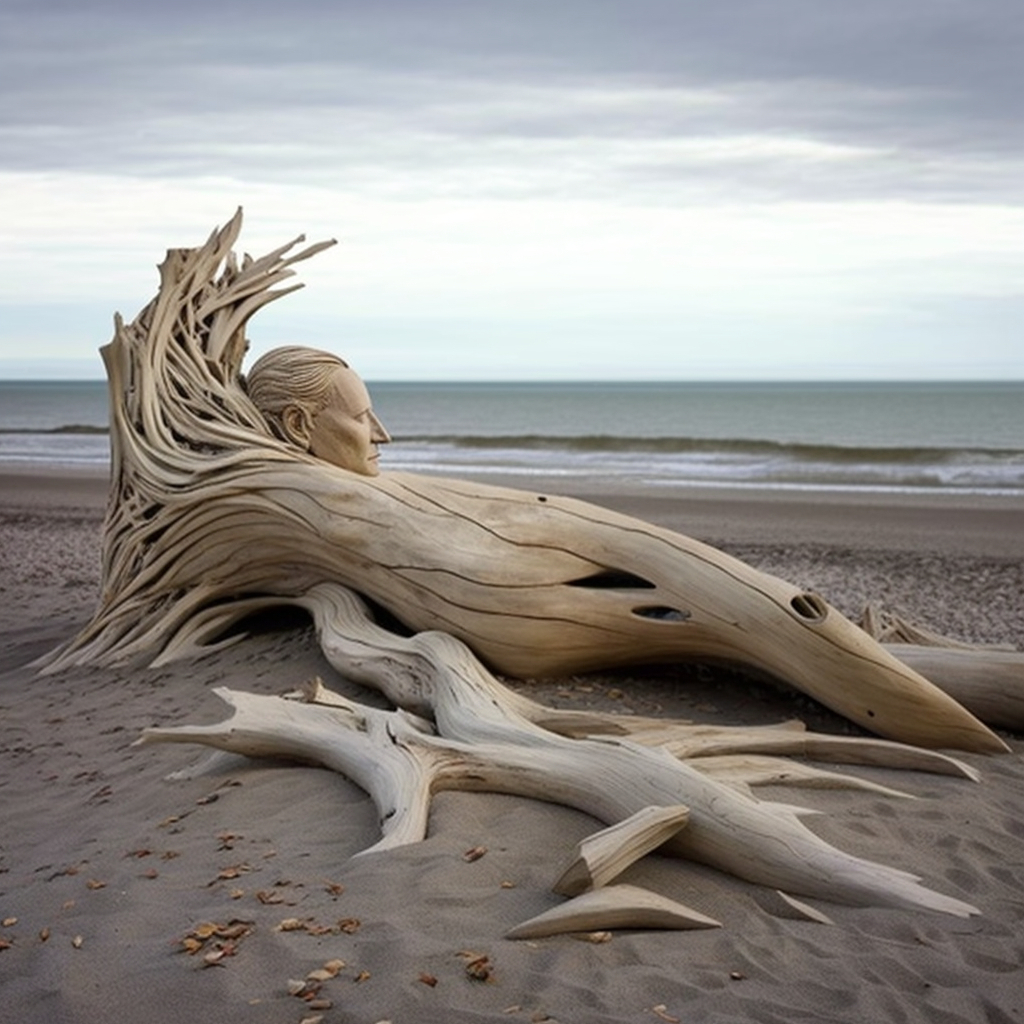
The project suffered from typical audio-game wayfinding problems. Around 2022-23, I began using Midjourney to generate reference images for hand-drawn silhouettes of strange, humanoid plants — prompts like “driftwood shaped like a sleeping person” or “moss ruin brain stem.” I isolated parts, drew over them multiple times to create line-boil animation, then placed them as 2D planes that always faced the player. The non-human recombination of human remnants felt thematically fitting. But I also took a shortcut: the pull of curiosity, the wonder of getting a response, the ease of generating content.
The inclusion of AI-derived artwork was not the only change between the two versions, as the first was interactive and the second was created as an endless stroll through a procedurally-generated landscape. The non-visual version has an abundance of ambiguity to the point where it might be difficult to ascertain its theme. With the visuals of the second, the empty post-humanness of the landscape and strangeness of the flora become more obvious, and I included animations of flooding. The rain is a prominent sound in both, but with the visuals, some of the subtle sounds of movement and life are less noticeable.
I was then only dimly aware of AI’s environmental cost and labor ethics. I felt my heavy editing excused it. But the process worsened my confidence rather than helping. Researchers call this “machinal bypass”: using AI to avoid emotional or intellectual labor that makes us vulnerable (Kaplan, et al, 1). I replaced part of the emotional labor of making with curating. Using AI in my work might have allowed for an intellectual distance. Deep Seek once told me (emphasis original): “AI collaboration offers a mirror to your own mind. It surprises you with your own latent ideas, remixed from everything it’s absorbed. The strangeness you felt might be seeing your own creative impulses reflected back, alienated.” In this sense, perhaps it is a machinic way to bypass self-reflection.
Moving Away
Post-pandemic, as in-person gatherings returned, I felt less interest in AI collaboration. Backlash grew: workers displaced, media platforms allowing AI-content filtering. My completed work became a burden — how to disclose AI use in exhibitions that only list title, date, medium? I still liked parts of it, but could not separate the two. Regret became a form of negation: a wish to reverse the action, to move away.
Apophatic mysticism teaches that “away” is more ambiguous than “toward.” Moving away from AI collaboration may point us toward what we have as human artists: immediacy, vulnerability, real connection. If creativity is historically associated with the divine (Arielli, 48), then regret over AI use might become a creative equivalent of apophatic mysticism — defining our practice by what it is not.
Coming Up for Air
Other artists model this. Matthias Moos’s smiley buoy — a painted buoy whose wave-distorted reflection resembles millions of AI-generated emoji variations — teaches us to see like AI without using it. Minrui Qiao’s Trace treats AI as “a system where fragments, errors, and gaps become sites of sense-making,” restoring agency through questions, not outputs.
Engaging with AI can be a back-and-forth: going deeply into the inhuman, then coming up for air. Dysphoric experiences — psychedelic, horrific, uncanny — can be transformative. AI horror (Loab, Deep Dream (Google Colab)) offers a negative point to move away from, toward a renewed sense of human creativity. The developers push toward seamlessness; artists can push toward the void. The void gives us something to leave behind.
Statement on the Use of AI for this Article
The human author wrote a 2800+ word essay (available here) that Deep Seek software edited and focused to 900 words and provided the abstract and some keywords. Citations were added later by the human author, as were some edits and additional explanation and context. We each wrote our own bios.
Bibliography
Arielli, Emanuele. “Techno-animism and the Pygmalion Effect.” Artificial Aesthetics: Generative AI, Art and Visual Media, edited by Lev Manovich and Emanuele Arielli. 2024, pp. 40-55, manovich.net/index.php/projects/artificial-aesthetics.
DeepSeek (深度求索). Response to user prompt regarding the experience of AI collaboration, Dec. 2025, large language model, chat.deepseek.com.
Google/Deepdream. 1 July 2015. Google, 8 Apr. 2026. GitHub, github.com/google/deepdream.
Kaplan, Deanna M., Roman Palitsky, and Charles L. Raison. “The ‘Machinal Bypass’ and How We’re Using AI to Avoid Ourselves.” Proceedings of the National Academy of Sciences 122, no. 51 (2025): e2518999122. doi:10.1073/pnas.2518999122.
Lucas, Hannah. “Negative Capabilities: Investigating Apophasis in AI Text-to-Image Models.” Religions, vol. 14, no. 6, June 2023, p. 812. DOI.org (Crossref), doi:10.3390/rel14060812.
Moos, Matthias. Smiley Buoy. 2025, matthiasmoos.com/portfolio_cpt/generative-work-without-the-digital/. Video.
Oldenburg, Aaron. A Mass of Radiant Flies and a Body. 2023, aaronoldenburg.itch.io/flies. Software.
Qiao, Minrui. Trace. 2025, anythingbutthis.xyz/artwork-pages/minrui-qiao.html. Algorithm, omnidirectional microphone, dot-matrix printer, live-stream camera, speaker, LED strip light.
Sacks, Oliver. “The Mind’s Eye.” The New Yorker, 20 July 2003, pp. 48–59.
Swanson, Steph Maj. Loab - the AI Cryptid. Apr. 2022, loab.ai. AI image.